

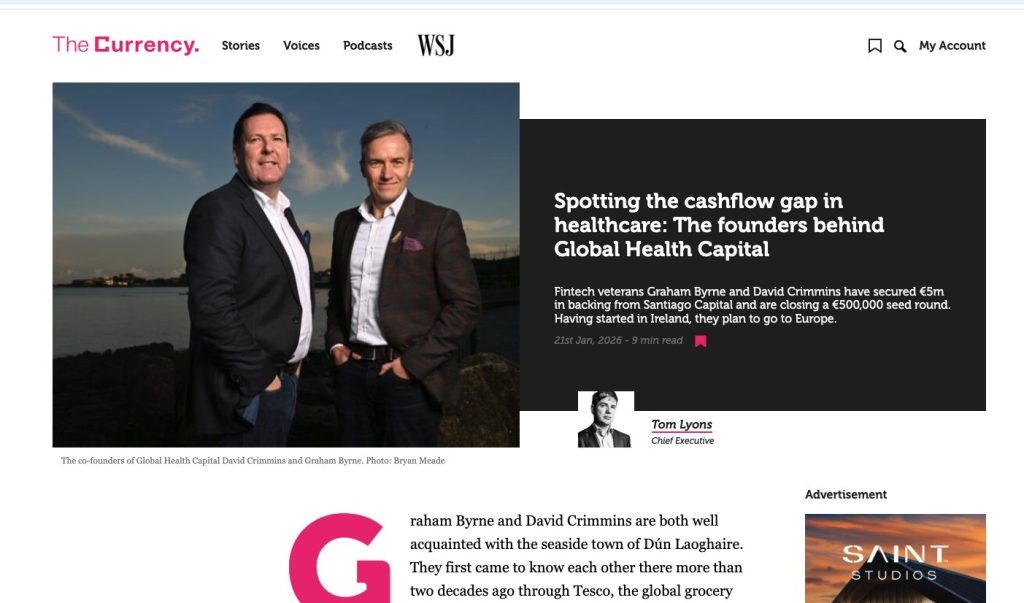
Spotting the cashflow gap in healthcare: The founders behind Global Health Capital
Graham Byrne and David Crimmins are both well acquainted with the seaside town of Dún Laoghaire. They first came to know each other there more than two decades ago through Tesco, the global grocery giant whose Irish headquarters is based in the town. At the time, Crimmins was helping to launch Tesco’s credit card in Ireland before going on to roll out other personal finance products. Byrne, then working with GE Capital, partnered with Tesco to provide complementary credit protection products.
So it is perhaps fitting that I meet them along the seafront, where, over coffee, Byrne and Crimmins explain why they decided to co-found Global Health Capital (GHC) last year.
The way the two founders tell it, they identified a clear gap in the market: medical professionals often need access to finance to invest in their practices or simply to cover day-to-day costs while waiting to be paid for their services.
Byrne brings deep fintech experience, having grown Bibby Financial Services in Ireland and later across Europe, while Crimmins previously helped build health insurer GloHealth and medical billing company MedServ. Backed with €5 million from alternative lender Santiago Capital, GHC launched late last year in Ireland, and it is already winning business from hospital consultants, dentists and pharmacists. The next step is to enter Britain.
From Tesco credit cards to tackling sleep disorders
David Crimmins never thought he would end up spending most of his career in Ireland. He emigrated to the United States after finishing his marketing and accounting degree at Trinity College Dublin in the mid-1990s, but he came home when his grandmother fell ill and passed away. Offered a temporary job in Hibernian Insurance, today Aviva, Crimmins assumed he would just work there for a few months before returning to America.
“I thought it was a job in marketing, but I was actually a secretary,” Crimmins said.
“I should have guessed it when I was asked to do a typing test.”
Crimmins did well, and a conversation with Dick Hartnett, then a manager in Hibernian who today is chief client officer with Sedgewick Ireland, convinced him to stay.
He worked his way into Hibernian’s marketing team, led by Paddy Lynch, who was launching its first credit card.
“Nobody on the marketing team wanted to handle the credit card as their background was either general or life insurance, so I volunteered to do it,” Crimmins said.
This experience prompted Tesco to hire him to work on its credit card, a joint venture with the Royal Bank of Scotland Ireland.
“I was the marketing manager for Tesco’s credit card in Ireland and then I became county manager of Tesco Personal Finance before becoming international commercial and marketing manager,” he said.
Tesco launched 15,000 cards in its first six months, and more products followed, including life insurance, motor insurance and loans. Tesco then asked Crimmins to help it launch in Tesco Thailand and Malaysia, so he was an internal consultant as well as an employee.
During this period, Crimmins struck up a friendship with Graham Byrne, though their careers remained largely separate. Crimmins left Tesco in late 2003 to join Simply Mortgages as chief revenue officer, where he helped grow the business to revenues of €20 million. He supported founder Peter Bastable in expanding the company’s product offering beyond mortgages into travel insurance, home insurance and personal loans.
In 2006, his father-in-law, Terry Sullivan, a former managing director of Clonmel Healthcare, asked him if he would set up a new stem cell business. Sullivan had teamed up with audiologist Dermot Dougan, a renowned audio specialist and expert witness in deafness claims, and they wanted Crimmins to investigate if there was a business in stem cells sourced from newborn baby umbilical cords.
“We were working with Mount Carmel [a maternity hospital] but then it ran into financial difficulties,” Crimmins recalled.
The business, Protectas Health, pivoted to the equine industry, and it set up the world’s first equine umbilical cord blood stem cell bank. “Our clients were all the major stud farms,” Crimmins said, adding that it also struck a licensing deal with a major Japanese company.
However, the financial crash arrived. “The thoroughbred business was badly hit, so we closed the business, but our licence with the Japanese continued,” he said.

Crimmins then joined GloHealth, a new health insurance business led by Jim Dowdall, the former chief executive of Aviva Ireland. “Jim is a tough guy to work for but he has very good attention to detail. Our target market was foreign direct investment – as they are companies that pay for really good healthcare and many of their people are in their 20s,” he said. “It was an intense three or four years.”
Crimmins left the company to start his own consultancy before he joined ResMed, a $35 billion company which specialises in treating sleep and respiratory disorders.
“I was working in strategic marketing and our job in Europe was to take our five-year strategy in America and localise it,” he said.
Crimmins also worked on various pilot projects to make diagnosing sleep disorders easier, as it is often unreported. “I was the bridge between these pilot projects,” he said.
Working on these projects, Crimmins got to know Oisin Kim, the co-founder of Medihive, a digital healthcare platform best-known for its subsidiary brand, the online doctor service Webdoctor.ie.
“Oisin asked me to join Medihive as CEO. He is the smartest tech guy I have ever met, but they needed help with the commercial side,” Crimmins said.
At the time, the company was generating less than €3 million in revenue. Crimmins helped lead two equity fundraising rounds and a debt raise, attracting backers including Alan Foy’s VentureWave Capital and his former employer, ResMed.
“We pretty much tripled the size of the company,” Crimmins said.
In mid-2023, he joined Cormac Loughrey’s medical billing company MedServ. “They are a company that prepares medical claims on behalf of hospital consultants to submit to hospitals,” he said.
“If you are a consultant, MedServ helps put the claim form together for consultants and submit it to a hospital which collates them and sends them on to private insurance companies.”
Crimmins noticed there could be long delays between a doctor performing a service and getting paid. “On the back of that I started to think was there an opportunity to potentially provide credit,” Crimmins said.
He asked his old friend Byrne to help him try and solve this problem, and out of that discussion came Global Health Capital.
Growing Bibby in Europe to Flendr
Graham Byrne began his career in financial services with Woodchester. He sold early retirement and salary protection schemes, overtime investments and pensions. In 1998, he was hired by GE Capital to work on long-term credit protection being sold through banks.
“That’s how I first met David when he was with Tesco Bank. I got the account so we were working together,” Byrne said.
In 2004, he joined Bibby Financial Services, a British business founded in 1982 to lend to SMEs.
“I went in as head of country and my role then was effectively pure business development,” Byrne said. “It was Bibby’s first ever greenfield project, as usually they enter a market by acquisition, but this was the middle of the Celtic Tiger so any potential buy had an astronomical price tag.”
Byrne started onboarding Irish clients with the support of Bibby’s international office based in Bambury, England. “It was mainly tricky, invoice discounting types of clients – construction companies, recruitment companies, haulage companies. The type of businesses banks wouldn’t touch with a barge pole,” Byrne said.
Byrne was told if he could win 12 clients in his first year then Bibby would open an office in Dublin. “I on-boarded 18, so they let me open an office in Sandyford with four staff,” he said. “We built the business from the ground up and we were growing by up to 20 per cent a year but from a low base.”
One of his first hires was Mark O’Rourke, who now runs the business. With the Irish economy performing strongly at the time, his England-based boss, Ed Rimmer, decided to carve out €150 million from a €1.5 billion facility raised from a banking syndicate led by Barclays. Byrne recalls signing the deal in the summer, just before the 2008 financial crisis.
“We went for an Indian in Banbury to celebrate,” he recalled. “And then I flew back to Dublin with €150 million.”
A few months later, credit dried up and banks started to fail. “I got a call from Barclays in Dublin asking for their money back but we had the capital,” he said.
Having money to lend put Bibby in Ireland at a huge advantage as no other Irish bank was lending. “We restructured Bibby to become an all-encompassing bank competitor,” Byrne said. “We exited smaller deals and we increased our funding range to start going after larger SMEs.”
Bibby tripled its market share in commercial finance, he said.
“We grew exponentially and we were making a significant profit,” he said. “Ireland became the posterboy for growth in Bibby.”
Byrne was promoted from leading Ireland to taking over its European business. “I went from 40 employees and a really nice business to 1,000 employees in 10 jurisdictions with 20 different operating companies,” he said.
Byrne restructured Bibby’s European business, expanding operations in France, Germany and Poland, while exiting Scandinavia and launching new businesses in the Netherlands and Belgium.
“It was flying in and out every day to a different office. I was away five days a week,” Byrne recalled.
In 2015, Byrne left to join Irish investment group Cardinal Capital. “My job was to set up a new division on the credit side,” he said.
The plan was to set up a new SME lending platform, but it didn’t happen.
“Cardinal is an amazing firm and I spent four great years there,” Byrne said. “But we actually got subsumed into all the private equity and commercial real estate activity we were involved in.”
By 2020, the fund was almost ready to launch when the pandemic struck.
“We had cornerstone investors, but once Covid came, understandably, they wanted to stay liquid so it was put on hold,” he said.
As the pandemic went on, he got itchy feet. “Some investors I knew had invested in Flendr, the peer-to-peer lending platform. They wanted to restructure it so they brought me in to try and fix it,” Byrne said. “It was to be a 12 to 18-month project, but I ended up staying three years. They had too many staff and the business was burning too much.”
Byrne’s goal was to fix the business in Ireland and make it equity investor-ready. “It took 18 months to do that, and then the existing shareholders followed their money and we went out to raise new capital,” he said. Russia, however, invaded Ukraine, so the price of capital shot up.
Byrne left the business in September 2023 after helping to transition it to new management. In early 2024, it entered examinership and emerged with new management and investors.
As his time at Flendr came to an end, Byrne began discussing financing opportunities in the medical sector with Crimmins, which ultimately led to the founding of Global Health Capital.
Expansion plans for Global Health Capital
Ireland represents a significant market opportunity for Global Health Capital. According to the Medical Council, there are more than 20,000 registered doctors in Ireland, around half of whom are general practitioners (GPs), most operating as sole traders or in small practices. In addition, there are over 4,000 consultants earning a mix of public and private income from treating patients.
Beyond doctors, the market includes approximately 7,000 pharmacists and 4,000 dentists. While Global Health Capital is starting in Ireland, it plans to expand into Britain and mainland Europe over time.
“It can take three months at its quickest and up to two years at an extreme to get paid,” Crimmins said. “It is not unusual for it to take nine to 12 or even 15 months for an invoice to be paid because of how the Irish private health care reimbursement system works.”
As a result, Crimmins said medical professionals faced funding gaps where they required finance to do something like expand their practices, acquire new equipment, pay a tax bill or insurance premium.
GHC has developed a range of products, such as Mediflow, which gives medical professionals access to pre-approved short-term loans based on their speciality and experience, to help them through these gaps.
Byrne said GHC used data that was both personal to the customer and based on their position and seniority to create an algorithm to process loans quickly.

“That’s the secret sauce,” he said. “We can calculate what a particular consultant is earning in a particular year and then give them a percentage of those earnings for 90 days in a revolving credit facility.”
GHC will lend up to €75,000 to medical professionals, but in time it may lend more. “When you ask a doctor about getting a loan, one of the biggest challenges is the length of time it takes to get one,” Crimmins said. “We have a digital first product that is super-easy to us – you put your details in, and then boom you know this is what you are preapproved for.”
The business has a €5 million credit from alternative lender Santiago Capital, which is also a minority shareholder in the business.
Its charges are 1.5 per cent per month. Crimmins said Global Health Capital has similarities to other lenders such as Wayflyer, but differs in that it is exclusively focused on medical professionals. Data on medical professionals’ earnings and credentials is readily available, making it easier to verify both income and identity than in many other sectors of the economy.
Byrne said GHC is already doing its first loans. “This is the start of many transactions. We have a €5 million capital fund for 2026, and this year we plan to close an equity funding round to support our entry into the UK market. Byrne said GHC was closing a €500,000 seed round from high net worth investors as part of this process,” Byrne said.
“We will need more capital as the size and scale of the UK is so much bigger.” He also said it was launching a product called Mediflex, which offers medical professionals cash advances based on credit card usage.
“It is not dissimilar to GridFinance but for medical professionals,” he said. “The other product we are going to launch is fixed-term loans from €100,000 to €1 million. That is where the biggest appetite is right now, but that will be different as it will be secured on assets.”
Byrne said there were specialist healthcare funders in the United States that were similar to what GHC was hoping to do. “In Europe, it is very hard to find anything similar,” he said. “So there is a big market.”
GHC has a €60 million lending target over the next three years in Ireland and Britain, before expanding in Europe.
“Ireland is an excellent beta market to launch in because of our reliance on private healthcare. But we want to scale and our plans are pretty aggressive,” Byrne said. “We want to go into the UK and replicate what we are doing here first and after that our next target will be Germany and possibly Scandinavia.”
Ready to Take Control of Your Finances?
Whether you’re starting out or scaling up, GHC gives doctors fast, flexible funding without the stress. No hoops. Just help.